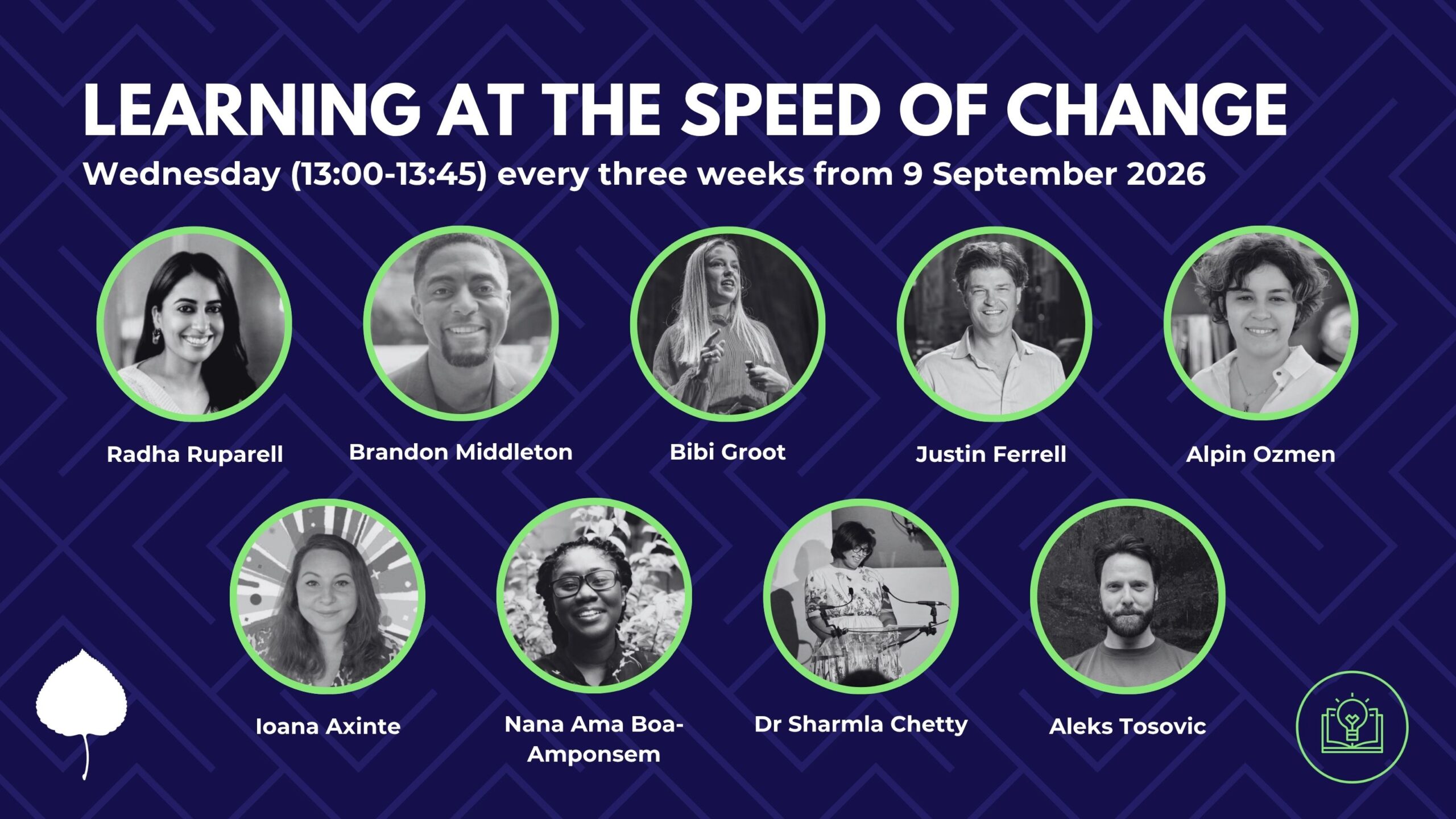
What is learning for and who gets to build it?
AI and other new technologies are changing how we learn, teach and work. But alongside questions about what these tools can do are some more fundamental ones: what is education actually for, what should people still be learning, and who gets to make those decisions?
This eight-part series brings together people working across education, technology, research and the workplace to explore those questions from different perspectives. Rather than treating schools, universities, businesses and technology companies as separate worlds, we want to put them in conversation with one another. What can a school leader learn from someone building an education platform? What does a researcher see differently from someone responsible for learning inside a large organisation?
Each 45-minute session focuses on one practical question, looking at what it means for us as individuals, for the organisations we work in, and for education more broadly. There will be a short opening provocation followed by an open discussion with the speaker and the group. At the end of each session, everyone will be asked to identify one thing they want to do, test or think differently about. We’ll return to those commitments in the final session in February.
Sessions are held under the Chatham House Rule and will not be recorded.
Events in the series:
Wednesday 9 September 2026:
What Is Learning For?
With Radha Ruparell – Chief Learning Officer, Global Institute for Shaping a Better Future (Teach For All)
AI can already complete tasks that once took years of education and training to master. So what do we still need people to learn? We’ll start the series by asking what education is trying to achieve in the first place — and whether our schools, universities and workplaces have a clear answer.
Wednesday 30 September 2026:
The Credential is Collapsing
with Brandon Middleton – Head of Education, Replit
Degrees, qualifications and CVs have long been used as shorthand for what somebody knows and can do. But that shorthand is becoming less reliable. We’ll look at how employers and educators can judge skills more meaningfully, what might replace traditional credentials, and who could lose out as the system changes.
Wednesday 21 October 2026:
Does Any of This Work?
With Bibi Groot – Chief Impact Officer, Eedi
Education is full of new tools, programmes and ideas promising better learning. How do we know which ones actually make a difference? This session looks at what good evidence in education really means, what organisations tend to measure instead, and how to tell the difference between something that is popular and something that improves outcomes.
Wednesday 11 November 2026:
Designing for Humans, Not Learners
with Justin Ferrell – Institute of Design at Stanford University (the d.school)
This will be a practical session about fixing learning experiences that do not work. Participants will bring an example from their own context — whether that is a lesson, training programme, onboarding process or product — and work through how it could be redesigned around the people who actually use it.
Wednesday 2 December 2026:
Building the Thing
with Ioana Axinte – Co-Founder, Play Moments
Good ideas do not always survive contact with the real world. This session looks at what happens when you actually try to build and introduce a new learning product or programme: what people use, what they ignore, what organisations buy but never adopt, and what changes when users are involved from the beginning.
Wednesday 6 January 2027:
The Access Question
with Nana Ama Boa-Amponsem – Assistant Director, Programs, The Education Collaborative
New technology can make education cheaper, more flexible and more widely available — but it can also deepen existing inequalities. We’ll look at who is benefiting from the changes happening now, who risks being left behind, and what the evidence tells us about whether technology is really widening access.
Wednesday 27 January 2027:
The Expertise Problem
with Dr Sharmla Chetty – Chief Executive Officer, Duke Corporate Education
What does it mean to be an expert when knowledge, technology and working practices are changing so quickly? We’ll discuss how leaders, teachers and organisations respond when they cannot possibly know everything themselves — and how to build cultures where learning, uncertainty and changing your mind are treated as strengths rather than weaknesses.
Wednesday 17 February 2027:
What You’ll Actually Do
with Alpin Ozmen – Client Director, Middle East & Asia, Duke Corporate Education
and Aleks Tosovic – Director of Workforce Consulting, SThree
The final session brings the whole series back to action. We’ll revisit the ideas and commitments made over the previous eight months, look at what has actually changed, and ask a simple question: what do you believe now that you didn’t believe when we started? From there, participants will decide what they want to take back into their own work.